
What is Sponsorship in the Merchant Navy and Why Is It Important?
Choosing a career in the Merchant Navy is a dream for thousands of Indian students who want a high-paying job, international exposure, and a disciplined lifestyle. However, one of the most confusing and misunderstood concepts for beginners is “sponsorship in the Merchant Navy.”
Many students hear words like sponsored college, company sponsorship, or guaranteed placement, but do not clearly understand what sponsorship actually means, why it is important, and how it affects their future career at sea.
This blog explains everything about Merchant Navy sponsorship in a simple way.
Table of Contents
What Is Sponsorship in the Merchant Navy?
Sponsorship in the Merchant Navy means a shipping company gives you a written assurance that it will provide you with onboard training and job placement after you complete your pre-sea training.
Unlike other fields, sponsorship in the Merchant Navy does NOT mean free education or a fee waiver. This is one of the biggest myths among students.
Simple Definition
Sponsorship in the Merchant Navy is a job guarantee from a shipping company that ensures onboard training after pre-sea education.
When a candidate gets sponsorship:
- The shipping company promises onboard training
- Sea-time training is guaranteed
- Placement after pre-sea course becomes secure
- No need to search for ships through agents
Common Myths About Merchant Navy Sponsorship
Many students misunderstand sponsorship due to incorrect information online or from agents.
Myth 1: Sponsorship means the company pays college fees
Reality: You pay the fees yourself. Sponsorship only guarantees onboard training and placement.
Myth 2: Sponsorship is optional
Reality: For many courses like DNS, sponsorship is almost mandatory to complete required sea-time.
Myth 3: Any college can give sponsorship
Reality: Only shipping companies conduct sponsorship exams. Colleges cannot give sponsorship on their own.
How Does Merchant Navy Sponsorship Work?
To understand sponsorship clearly, you need to understand the structure of Merchant Navy training.
Step-by-Step Process
- Apply for sponsorship exams conducted by shipping companies. Learn more about it here.
- Clear written test, psychometric test, interview, and medical
- Receive a sponsorship letter
- Join a sponsored pre-sea college affiliated with the company
- Complete pre-sea training
- Join ship for onboard training (sea-time)
This system ensures you do not struggle later to find a ship.
Sponsored vs Non-Sponsored Colleges in the Merchant Navy
Understanding this difference is extremely important before taking admission.
Sponsored Colleges
Sponsored colleges allow admission only after clearing a company sponsorship exam.
Key Features:
- Admission after sponsorship letter
- College linked with shipping company
- Onboard training included in academic structure
- Guaranteed placement after pre-sea training
- Higher fees (because sea training is included)
Sponsored colleges remove uncertainty from your career.
Non-Sponsored Colleges
Non-sponsored colleges focus only on pre-sea training.
Key Features:
- Easy admission process
- Lower academic fees
- No guarantee of onboard training
- Students must find ships on their own
- High dependency on agents
- Risk of delay or fraud
Many students from non-sponsored colleges spend years searching for ships.
Recommended Read: 4 Must-Apply Sponsorship Exams for Merchant Navy
Why Is Sponsorship Important in the Merchant Navy?
Sponsorship is not just an advantage; it is often a career-saving factor.
1. Sponsorship Guarantees Onboard Training
Every Merchant Navy officer must complete onboard training to get promoted. Without sea-time, you cannot:
- Appear for Certificate of Competency exams
- Get higher ranks
- Continue your career at sea
For example, DNS students must complete 18 months of onboard training. Without sponsorship, many students fail to find a ship for this training.
When you have sponsorship, the shipping company places you on its ship. You do not have to search or depend on agents.
2. Sponsorship Gives Job Security From the Start
Sponsorship gives you clarity about your future.
When a company sponsors you:
- Your job path is clear before you join college
- You do not worry about placement after training
- You focus fully on studies and skill development
In a competitive field like Merchant Navy, this early job security is a big advantage.
3. Sponsorship Protects You From Fake Agents
Many unsponsored students fall into traps.
Without sponsorship, students often:
- Pay a large amount of money to agents
- Get false promises of placement
- Wait for years without getting a ship
Sponsored students deal directly with shipping companies. This removes the risk of cheating and fraud.
4. Sponsorship Saves Time, Money, and Stress
At first, non-sponsored colleges look cheaper. Later, they often cost more.
Without sponsorship:
- You may pay extra for sea training
- Your career may get delayed
- You may lose income due to waiting time
Sponsored colleges include onboard training. This saves time, money, and mental stress in the long run.
5. Sponsorship Helps You Grow Faster in Your Career
In Merchant Navy, experience matters more than certificates.
When you complete sea-time on time, you can:
- Appear for promotion exams sooner
- Get higher ranks faster
- Increase your salary earlier
Sponsored students usually complete training on schedule. Unsponsored students often face long delays.
6. Sponsorship Builds Your Credibility
Shipping companies conduct strict selection before giving sponsorship.
They test:
- Academic knowledge
- Thinking ability
- Attitude and discipline
- Medical fitness
When you clear these tests, the company trusts you. This gives you strong credibility in the maritime industry.
7. Sponsorship Gives Better Training Exposure
Sponsored cadets usually train on:
- Well-maintained ships
- Ships with experienced officers
- Ships that follow proper safety standards
This helps you learn faster and become a confident officer.
8. Sponsorship Reduces Risk During Market Downturns
Shipping is affected by global markets.
During slow periods:
- Companies reduce hiring
- Unsponsored cadets wait longer
- Freshers struggle the most
Sponsored candidates already have a place. They face fewer problems during recessions.
9. Sponsorship Gives Peace of Mind to Parents
Merchant Navy education needs a large investment.
Parents worry about:
- Job assurance
- Safety of their child
- Return on money spent
Sponsorship reduces these worries. It shows a clear path from training to job.
10. Sponsorship Builds a Strong Career Foundation
Sponsorship does not help only in the first job. It helps throughout your career.
It gives you:
- Industry exposure from day one
- Strong professional habits
- Long-term career stability
Many sponsored cadets continue sailing with the same company for years.
Why Sponsorship Is Mandatory for Certain Merchant Navy Courses
Certain Merchant Navy courses require mandatory sea-time training to become eligible for higher ranks.
Example: Diploma in Nautical Science (DNS)
- DNS is a 1-year pre-sea course
- After DNS, 18 months of onboard training is compulsory
- Without sponsorship, students struggle to find ships
- Without sea-time, you cannot appear for Second Mate CoC exams
This is why for DNS, sponsorship before joining the course is strongly recommended.
Who Can Apply for Sponsorship in the Merchant Navy?
Eligibility for sponsorship depends on the course you are applying for.
Example: DNS Sponsorship Eligibility
- 12th pass with Physics, Chemistry, Maths
- Minimum 60% marks (varies by company)
- Good English communication
- Medically fit as per maritime standards
Always check eligibility before applying.
Medical Fitness: A Critical Part of Sponsorship in the Merchant Navy
Medical fitness is non-negotiable in Merchant Navy.
Key Medical Requirements:
- Eyesight: 6/6 vision
- No color blindness
- Good hearing and physical health
- Fit skeletal and respiratory system
Many students clear exams but fail medical tests.
It is strongly advised to get medical tests done before preparation.
Merchant Navy Sponsorship Assessment Process
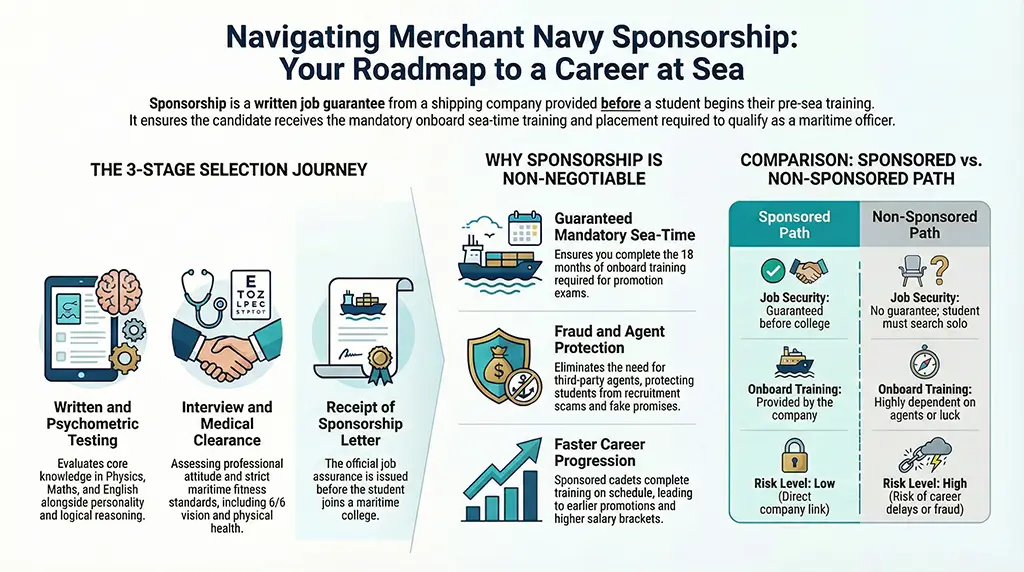
Sponsorship exams usually consist of four stages.
1. Written Test
The written test is similar to IMU-CET.
Subjects Included:
- Physics
- Chemistry
- Mathematics
- English
- General Aptitude
Most questions come from 12th PCM syllabus. Physics and Maths carry more weight.
2. Psychometric Test
This test checks your personality and mindset.
Two Types of Questions:
- Aptitude-based (logic, reasoning, numerical ability)
- Situation-based (reaction to real-life onboard situations)
Shipping companies want disciplined, honest, and responsible candidates.
3. Interview Round
The interview is simple but important.
Common Questions:
- Why do you want to join the Merchant Navy?
- What are your strengths and weaknesses?
- How do you handle pressure?
Basic maths or physics questions may be asked.
4. Medical Examination
Final medical test as per maritime standards.
Failure here means rejection regardless of exam performance.
What Is the Syllabus of Merchant Navy Sponsorship Exams?
Written Exam Syllabus
- Physics (mechanics, electricity, basics)
- Mathematics (algebra, trigonometry, calculus basics)
- Chemistry (basic concepts, reactions)
- English (grammar, comprehension)
- General aptitude
Psychometric Test Focus
- Logical thinking
- Decision-making ability
- Ethical judgement
- Stress handling
Confused about sponsorship exams? Get structured guidance from experienced marine professionals.
How to Prepare for Merchant Navy Sponsorship Exams?
Preparation can be done in two ways:
Self-Preparation
- Study 12th PCM concepts
- Practice aptitude questions
- Improve English communication
- Prepare interview answers
Professional Coaching
- Structured syllabus
- Psychometric training
- Interview guidance
- Medical assistance
Both methods work, but structured preparation improves success rate.
When Should You Apply for Sponsorship?
Best Time:
- Immediately after 12th results
- Before joining DNS or Nautical Science courses
Early sponsorship gives you:
- Better college options
- Less stress
- Clear career direction
Risks of Joining the Merchant Navy Without Sponsorship
Many students ignore sponsorship and regret it later.
Major Risks:
- Difficulty finding ships
- High agent fees
- Career delays of 1–3 years
- Mental stress and financial burden
- Risk of fraud
This is why sponsored colleges are always recommended.
Recommended Read: How to get sponsorship in the Merchant Navy in India: A-Z Guide
Final Verdict: Is Sponsorship Worth It?
Yes, sponsorship is absolutely worth it.
It provides:
- Career security
- Guaranteed training
- Peace of mind
- Faster promotions
For a competitive field like Merchant Navy, sponsorship is the safest and smartest choice.
Frequently Asked Questions (FAQs)
1. What is sponsorship in the Merchant Navy?
Sponsorship means a shipping company selects you and guarantees onboard training and placement after you complete your pre-sea course. It does not mean free education or fee payment by the company.
2. Why is sponsorship important in the Merchant Navy?
Sponsorship is important because onboard training is compulsory for career growth. Without sponsorship, many students struggle to find ships and their careers get delayed.
3. Does sponsorship mean the company pays my fees?
No. You must pay your college fees yourself. Sponsorship only guarantees sea-time training and job placement, not financial support for education.
4. Can I get sponsorship after joining a non-sponsored college?
Yes, but it is harder. Shipping companies prefer candidates with early sponsorship. Getting sponsored before joining a course gives better chances.
5. What tests are included in sponsorship exams?
Sponsorship exams usually include a written test, a psychometric test, an interview, and a medical examination. You must clear all stages to get selected.
6. What subjects should I prepare for sponsorship exams?
You should prepare Physics, Chemistry, Mathematics, English, and General Aptitude based on the 12th standard syllabus. Physics and Maths carry more weight.
7. What medical requirements are needed for sponsorship?
You must have 6/6 eyesight, no color blindness, good hearing, and overall physical fitness. Medical fitness is mandatory for selection.
8. Are sponsored colleges better than non-sponsored colleges?
Yes. Sponsored colleges offer guaranteed onboard training and placement, while non-sponsored colleges only provide pre-sea training with no job assurance.
9. When should I start preparing for sponsorship exams?
You should start preparing during or immediately after your 12th standard. Early preparation improves your chances of clearing exams and getting sponsorship.
10. Is coaching necessary to clear sponsorship exams?
Coaching is not mandatory, but it helps. Structured coaching provides exam-focused preparation, psychometric training, interview guidance, and medical awareness. This improves confidence and success rate, especially for first-time candidates.