
Graduate Marine Engineering (GME) Course: All You Need to Know
Have you ever watched massive cargo ships cutting through the ocean and wondered what keeps them running? Behind that power lies a complex engine room handled by skilled marine engineers. While most people notice the deck and navigation, the real heartbeat of the vessel lies deep inside the Engine Department.
If you’ve ever imagined working with powerful engines, managing advanced machinery, and traveling across oceans, then this path might be exactly what you’re looking for. In this guide, we’ll explore how the Graduate Marine Engineering (GME) course can take you from a mechanical engineering graduate to a Chief Engineer onboard a ship.
Table of Contents
What is Graduate Marine Engineering (GME)?
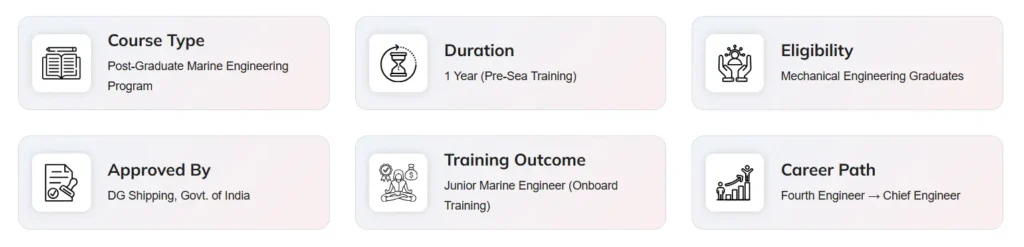
Graduate Marine Engineering (GME) is a one-year diploma program designed specifically for mechanical engineering and naval architecture graduates who want to enter the shipping industry.
This course focuses on:
- Ship machinery and engine systems
- Marine operations and maintenance
- Practical onboard engineering knowledge
Students receive both theoretical understanding and practical exposure to ship operations. Many institutes offering GME operate under the guidelines of the Directorate General of Shipping, ensuring standardized training and smooth admission processes.
After completing the course, candidates typically begin their careers as Junior Engineers and later appear for the MEO Class IV exam to become a 4th Engineer onboard ships.
Why is Graduate Marine Engineering (GME) Course Important?
Graduate Marine Engineering (GME) plays a crucial role in helping engineering graduates enter the Merchant Navy efficiently. It acts as a bridge between classroom knowledge and real-world marine applications.
Here’s why it matters:
- Gateway for Mechanical Engineers
Mechanical and naval architecture graduates can directly transition into maritime careers through GME. - Cost-Effective Option
Compared to full-time marine engineering degrees, GME is more affordable and accessible, especially for middle-class students. - Practical Application of Knowledge
It converts theoretical mechanical concepts into real ship-based applications. - Skill Identification
The course helps students understand their strengths and areas of improvement in a demanding marine environment.
In simple terms, Graduate Marine Engineering transforms a land-based engineer into a ship-ready professional.
Eligibility to Do the Graduate Marine Engineering (GME) Course
To apply for the GME course, candidates must meet certain academic, medical, and general requirements as defined by the Directorate General of Shipping. While specific criteria may slightly vary across institutes, the core eligibility remains largely the same.
Academic Requirement
Educational Qualification:
- Candidates must have completed a B.E. / B.Tech in Mechanical Engineering from a recognized university.
- Most institutes require a minimum of 50–60% aggregate marks, depending on their admission standards.
Age Limit
Applicants should not be more than 28 years old at the time of course commencement, as per DG Shipping guidelines.
Medical Fitness
Medical standards are strict for a sea-going career. Candidates must:
- Meet DG Shipping medical standards
- Have no colour blindness
- Possess good eyesight and overall physical fitness
A medical examination by an approved doctor is mandatory before final selection.
Additional Requirements
Apart from academics and medical fitness, candidates should also fulfill the following:
- Hold a valid passport
- Clear background verification checks
- Demonstrate basic English language proficiency (reading, writing, and speaking)
Meeting all these criteria is essential to ensure you are fit for the demanding and disciplined life at sea.
Check Your Eligibility To Join the Graduate Marine Engineering (GME) Course
Choosing the right path in the Merchant Navy can be confusing, especially when different courses have different eligibility criteria. To simplify this, you can use the Merchant Navy Eligibility Checker by Rife.
This tool allows you to:
- Answer a few simple multiple-choice questions
- Instantly check your eligibility for multiple Merchant Navy courses
Instead of guessing or manually comparing requirements, this tool gives you a clear direction based on your profile, helping you choose the most suitable course and career path in the Merchant Navy.
Graduate Marine Engineering (GME) Course Benefits
Graduate Marine Engineering serves as a direct entry route into the Merchant Navy for mechanical engineers. It provides a compact yet comprehensive understanding of ship operations and engineering systems.
Key benefits of the course include:
1. Entry into Merchant Navy Careers
The course prepares candidates for roles like Trainee Marine Engineer, forming the base of a maritime career.
2. High Value for Engineers
It enhances the value of a mechanical engineering degree by opening international career opportunities.
3. Strong Technical Foundation
Students gain focused knowledge about marine engines, auxiliary systems, and onboard operations.
4. Practical Skill Development
Hands-on training ensures students are ready to handle real-time challenges onboard ships.
This Course is Ideal for Students Who:
- Are Mechanical Engineering graduates
- Want an officer-level career in the Merchant Navy
- Prefer technical and machinery-focused roles
- Seek high-paying global careers at sea
- Enjoy problem-solving and hands-on engineering
- Are comfortable with engine room responsibilities and sea life
Graduate Marine Engineering (GME) Course Highlights
| Feature | Details |
| Course Level | Post-graduate (PG) |
| Accommodation | Residential |
| Course Fees | INR 4,00,000 – 7,00,000 |
| Entrance Exams | Conducted by colleges/companies |
| Top Institutes | Anglo-Eastern Maritime Academy, IMS Goa, Seven Islands |
Graduate Marine Engineering (GME) Course Fees
One of the biggest advantages of GME is that it delivers specialized maritime training within a short duration and relatively reasonable cost.
Typically, fees range between ₹3,00,000 to ₹4,00,000 for the one-year course.
Below are the fees for top institutes:
| GME College | Fees |
| Anglo-Eastern Maritime Academy | ₹6,85,000 |
| IMS Goa | ₹6,42,000 |
| Seven Islands | ₹6,58,000 |
Graduate Marine Engineering (GME) Syllabus
The GME syllabus is designed to build a strong foundation not only in marine engineering concepts but also in aptitude, communication, and industry awareness. Based on the official syllabus structure, the course covers multiple subjects that prepare candidates for both academic assessments and real-world maritime challenges.
1. Verbal & Non-Verbal Reasoning
This section focuses on analytical thinking, logical reasoning, and problem-solving abilities.
Key topics include:
- Time, Speed and Distance
- Time and Work
- Percentage, Profit & Loss
- Ratio and Proportion
- Simple & Compound Interest
- Pipes and Cisterns, Averages
- Calendar and Clock Problems
- Direction Sense and Blood Relations
- Series, Analogy, Classification
- Mirror Image and Pattern Recognition
- Figure Matrix and Paper Folding
- Rule Deduction and Logical Analysis
- Cubes & Dice, Image Analysis
These topics help improve decision-making and reasoning skills required in competitive exams and onboard situations.
2. Marine Knowledge
This subject introduces candidates to the maritime world and builds industry awareness.
Topics covered:
- Introduction to Merchant Navy
- Role of IMO and Directorate General of Shipping
- Career progression in Merchant Navy
- Types of ships and cargo
- Major ports in India and globally
- International sea routes and shipping canals
- Maritime days and global shipping importance
- Advantages and challenges of a seafaring career
3. English
Strong communication skills are essential for working in multinational ship environments.
Core topics include:
- Nouns, Pronouns, Verbs
- Adverbs, Modals, Determiners
- Prepositions and Sentence Structure
- Direct & Indirect Speech
- Active & Passive Voice
- Tenses and Grammar Rules
- Synonyms and Antonyms
- Error Detection and Usage
4. Marine Technology
This subject provides a basic understanding of technical aspects related to ships and marine systems.
- Introduction to Marine Technology
- Overview of ship machinery and systems
5. Psychology
This section evaluates personality, behavior, and decision-making under pressure, which are important traits for life at sea.
Topics include:
- Introduction to Psychology
- Non-verbal Communication
- Situation Reaction Test (SRT)
- Thematic Apperception Test (TAT/PPT)
- Word Association Test (WAT)
- Self-Descriptive Test (SD)
6. Hydrodynamics
This subject focuses on the behavior of fluids and their interaction with ships.
- Basics of Hydrodynamics
- Fluid motion and marine applications
7. Structural & Mechanical Applications
This section connects engineering fundamentals with real-world ship operations.
- Structural concepts in ships
- Mechanical systems and applications onboard
Overall, the GME syllabus is a combination of technical knowledge, aptitude skills, and personality development, ensuring that candidates are fully prepared for both entrance exams and a professional career in the Merchant Navy.
Admission Process of GME
The admission process for the GME course is structured to ensure that only eligible and medically fit candidates enter the Merchant Navy. It involves multiple stages, starting from application to onboard placement.
1. Application & Counselling
The first step is to submit your application to the institute or training partner.
At this stage:
- Your basic eligibility is checked (education, age, marks)
- You may receive guidance or counselling to understand the course and career path
2. Written Test / Interview
Once shortlisted, candidates are required to appear for:
- A written examination and/or
- A personal interview, depending on the institute or sponsoring company
This stage evaluates your:
- Technical knowledge
- Communication skills
- Overall personality
3. DG Shipping Medical
Candidates who clear the selection rounds must undergo a mandatory medical examination as per standards set by the Directorate General of Shipping.
This includes:
- Eyesight and color vision test
- Hearing ability
- Overall physical fitness
Clearing this stage is essential to proceed further.
4. Admission Confirmation
After successfully passing all stages:
- You receive an admission confirmation
- You are enrolled in a DG Shipping approved institute
This officially secures your seat in the GME program.
5. Pre-Sea Training
Candidates then undergo 12 months of residential pre-sea training, where they learn:
- Marine engineering concepts
- Ship machinery handling
- Safety procedures and practical skills
6. Onboard Placement
After completing training:
- Candidates are placed onboard ships as Trainee Marine Engineers
- This marks the beginning of their professional journey in the Merchant Navy
How to Apply for Graduate Marine Engineering (GME) Course
Applying for the GME course is a straightforward process, but it requires careful attention to detail at each step. Even small mistakes can delay or affect your application, so it’s important to follow the process properly.
Step 1: Fill Application Form
The first step is to apply through the official website of the college or training institute you are targeting.
While filling out the form:
- Enter all details accurately, including personal, academic, and contact information
- Upload required documents such as mark sheets, passport-size photo, and ID proof
- Double-check all entries before submission, as incorrect information can lead to rejection
Some institutes may also ask for additional details like passport status or medical history, so keep those ready in advance.
Step 2: Pay Application Fees
Once the application form is submitted:
- You will receive a payment link or instructions via email/SMS
- Pay the application fee using available methods such as online banking, UPI, or card payment
After payment:
- Save the payment receipt or confirmation for future reference
- Ensure the payment status is successful to avoid issues with your application
Step 3: Book Your Seat / Exam Slot
After completing the application and payment:
- Some institutes allow you to select your preferred exam date and center
- Others may automatically assign a slot and notify you via email
Make sure to:
- Check your email regularly for updates and admit card details
- Prepare accordingly for the entrance test or interview schedule
Top Graduate Marine Engineering Colleges
When selecting a GME college, one factor matters more than anything else – approval by the Directorate General of Shipping. Only DG Shipping-approved institutes are valid for Merchant Navy careers. Choosing a non-approved college can make your certification invalid, so this should always be your first checkpoint.
Here’s a quick overview of some of the top DG-approved GME colleges in India, along with key highlights:
1. Anglo-Eastern Maritime Academy (AEMA)
- Location: Karjat, Maharashtra
- One of the leading academies backed by the Anglo-Eastern Group (managing 600+ ships)
- Strong placement support with Anglo-Eastern fleet
- Fees: ₹7,60,000
2. Samundra Institute of Maritime Studies (SIMS)
- Location: Lonavala, Maharashtra
- Advanced training institute with modern facilities
- Sponsored by Executive Ship Management
- Fees: ₹6,76,800
3. TS Rahaman Institute
- Location: Mumbai, Maharashtra
- One of India’s oldest maritime institutes
- Offers multiple pre-sea and post-sea programs
- Placement support with major shipping companies
- Fees: ₹3,95,000
4. Great Eastern Institute of Maritime Studies (GEIMS)
- Location: Lonavala, Maharashtra
- Known for strong industry connections
- Placement opportunities with leading global shipping companies
- Fees: ₹6,51,512
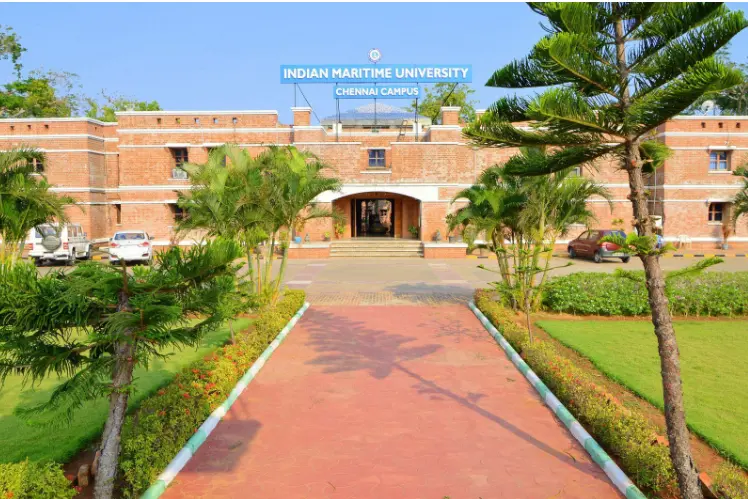
5. Indian Maritime University (IMU)
- Location: Mumbai Port Campus
- Government university offering a wide range of maritime courses
- One of the most reputed institutes in India
- Fees: ₹2,75,000 (male), ₹1,40,000 (female)
6. AMET University
- Location: Chennai, Tamil Nadu
- Member of the International Association of Maritime Universities
- Strong placement ties with companies like Maersk and V-Ships
- Fees: ₹3,55,000
7. HIMT College
- Location: Chennai, Tamil Nadu
- Offers multiple DG-approved maritime courses
- Sponsorship and placement support available
- Fees: ₹4,15,000
8. UV Patel College of Maritime Studies
- Location: Mehsana, Gujarat
- Well-known institute in western India
- Campus recruitment by companies like Adani Group and Essar Shipping
- Fees: ₹3,80,000
9. Vels Academy of Maritime Education and Training
- Location: Chennai, Tamil Nadu
- Equipped with advanced engine simulators
- Industry exposure with major recruiters
- Fees: ₹3,00,000
10. International Maritime Institute (IMI)
- Location: Noida, Uttar Pradesh
- Strong industry tie-ups with companies like Maersk and MSC
- Sponsored cadets get structured onboard training
- Fees: ₹5,82,000
Choosing the right college is not just about fees, but about placement support, sponsorship opportunities, and training quality. Always verify DG Shipping approval and focus on institutes that provide strong industry connections to ensure a smooth transition from training to onboard career.
Get Into the Right GME College with Strong Sponsorship Preparation

Getting admission into a good GME college is important, but clearing sponsorship exams is what actually secures your career at sea. Rife Consultancy focuses heavily on technical preparation for sponsorship, especially through its dedicated Mechanical for GME Sponsorship Exams study material.
Focus on Sponsorship: The Real Game Changer
Many students get admission but struggle to clear company tests. Rife ensures you are fully prepared with concept clarity + application-based learning.
With Rife’s Mechanical course, you cover:
- Engineering Mechanics & Strength of Materials
- Thermodynamics, Heat Engines & Boilers
- Marine Diesel Engines (2-stroke & 4-stroke)
- IC Engines, Fuel Systems, Pumps & Compressors
- Refrigeration & Air Conditioning
- Machine Tools & Manufacturing
- Marine Safety & Maintenance Practices
Along with this, you get:
- Sponsorship exam-oriented questions
- Technical interview question sets
- Concept-based notes with diagrams
- Practice aligned with real company test patterns
Complete Support from Start to Finish
Rife supports you beyond just preparation:
- College Selection Guidance: Choose the right DG-approved GME college
- Eligibility Check & Counselling: Know your chances and improve gaps
- Admission & Documentation Support: Smooth application process
All-in-One Preparation System
- Online Coaching (PAN India) – Live + recorded classes
- Offline Coaching (Surat) – Small batches with personal mentoring
- Mock Tests – Real exam pattern with All India ranking
- Study Material – Focused content for sponsorship exams
Why Rife Stands Out
- Specialized Mechanical course for GME sponsorship
- Focus on technical + interview readiness
- Merchant Navy experts as mentors
- Continuous doubt-solving and academic support
If your goal is not just to join a GME college but to secure sponsorship and start sailing faster, Rife gives you the right preparation, guidance, and edge to make it happen.
Frequently Asked Questions (FAQs)
1. What is the duration of the Graduate Marine Engineering (GME) course?
The Graduate Marine Engineering (GME) course is typically a 1-year program, including pre-sea training, followed by onboard training.
2. Who is eligible for the Graduate Marine Engineering (GME) course?
Candidates with a B.E./B.Tech in Mechanical Engineering or Naval Architecture with minimum required marks can apply.
3. What is the maximum age limit for the Graduate Marine Engineering (GME) course?
The age limit is generally 28 years, as per guidelines of the Directorate General of Shipping.
4. Is the Graduate Marine Engineering (GME) course approved by DG Shipping?
Yes, the Graduate Marine Engineering (GME) course must be conducted by institutes approved by the Directorate General of Shipping to be valid.
5. What happens after completing the Graduate Marine Engineering (GME) course?
After completion, candidates join ships as Trainee Marine Engineers and later appear for competency exams to become engineers onboard.
6. What is the average fee for the Graduate Marine Engineering (GME) course?
Fees usually range between ₹3,00,000 to ₹7,00,000, depending on the institute.
7. Is sponsorship necessary for the Graduate Marine Engineering (GME) course?
While not mandatory in all cases, having sponsorship from a shipping company greatly improves placement chances.
8. What medical requirements are needed for the Graduate Marine Engineering (GME) course?
Candidates must meet DG Shipping medical standards, including good vision, no color blindness, and overall fitness.
9. Can diploma holders apply for the Graduate Marine Engineering (GME) course?
No, the Graduate Marine Engineering (GME) course is specifically for degree holders in Mechanical Engineering or Naval Architecture.
10. Is the Graduate Marine Engineering (GME) course a good career option?
Yes, the Graduate Marine Engineering (GME) course offers high salary potential, global exposure, and strong career growth in the Merchant Navy.