
Merchant Navy Sponsorship Interview: Top 10 Tips for Preparation
Getting a call for your Merchant Navy sponsorship interview feels exciting, doesn’t it? You’ve studied for the written exam, practised questions, and finally made it to the next stage. But then comes the big question: Are you actually prepared for the interview?
Table of Contents
Many students focus so much on clearing the written exam that they forget about the interview. They struggle with simple questions like “Why do you want to join the Merchant Navy?” or get nervous when asked about their subjects, family, or life at sea.
The good news is that you don’t need to be a perfect speaker or know every answer. You just need to understand what interviewers look for and prepare the right way. In this blog, we’ll cover 10 things you should prepare before your Merchant Navy sponsorship interview so you can walk in feeling more confident and ready to answer.
Key Takeaways
- Revise your Class 11 and Class 12 Physics, Mathematics, and other relevant technical concepts.
- Practise speaking in English clearly and answering questions without rushing.
- Understand the Merchant Navy, your chosen course, and the shipping company you are applying to.
- Prepare for personal questions, group discussions, psychometric tests, and medical requirements.
- Stay calm, answer honestly, and practise mock interviews before the actual selection round.
Merchant Navy Sponsorship Interview: 10 Tips
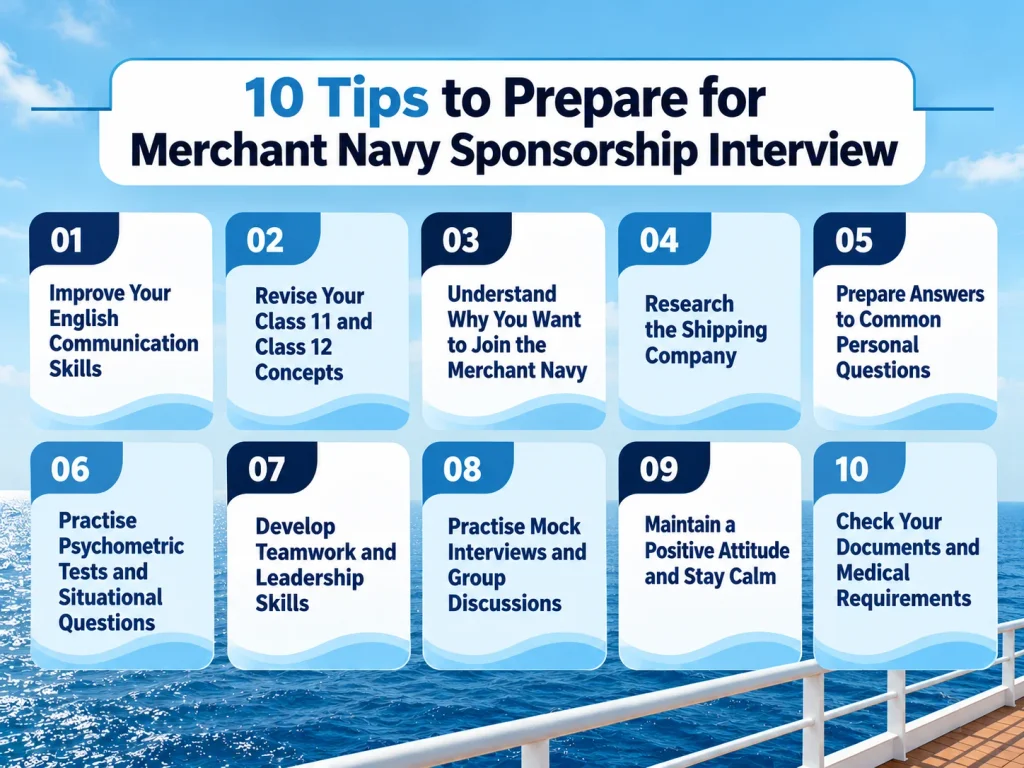
1. Improve Your English Communication Skills
Good communication is important for Merchant Navy professionals because they work with people from different backgrounds and nationalities. During your sponsorship interview, the panel may assess how clearly you explain your thoughts and understand questions.
You do not need to speak English with a particular accent or use difficult words. Focus on speaking clearly, using correct sentences, and expressing your answers confidently.
How to prepare:
- Read English articles or maritime related news aloud every day.
- Practise answering common interview questions with a friend.
- Record yourself speaking and identify areas where you need improvement.
- Listen carefully to questions before answering.
For example, practise answering “Tell me about yourself” in about one to two minutes. Include your education, interests, strengths, and reasons for choosing the Merchant Navy.
2. Revise Your Class 11 and Class 12 Concepts
Do not assume that the technical interview will be easy because you have already cleared the written examination. Interviewers may ask you to explain basic concepts or solve simple problems to understand how well you know your subjects.
Revise important Physics and Mathematics topics relevant to your course. For marine engineering applicants, understanding basic mechanical and electrical concepts can also be useful.
For example, revise Newton’s laws of motion, force, pressure, heat, electricity, basic calculations, and other topics from your school syllabus.
How to prepare: Make a list of important topics, revise your notes, and practise explaining concepts in your own words. If you cannot explain a concept simply, spend more time understanding it.
3. Understand Why You Want to Join the Merchant Navy
One of the most common interview questions is, “Why do you want to join the Merchant Navy?”
The interviewer wants to understand your motivation and whether you know what the career involves. An answer focused only on salary or travelling may not show that you have considered the responsibilities of working at sea.
Think about what genuinely interests you. It could be the technical nature of the work, learning about ships, working in an international environment, or building a career in the maritime industry.
You should also understand the challenges, including spending long periods away from home, following strict safety rules, and working as part of a team.
How to prepare: Write down your real reasons for choosing this career and practise explaining them naturally. Avoid memorising an answer that does not reflect your own thoughts.
4. Research the Shipping Company
Before attending your sponsorship interview, learn about the company you have applied to. Knowing basic information shows that you have taken the selection process seriously.
Find out what the company does, what types of vessels it operates, and which courses or sponsorship opportunities it offers. Also, understand the requirements mentioned in the company’s recruitment notice.
You can research companies such as Maersk, MSC, Fleet Management, Anglo Eastern, and Synergy Marine Group, depending on their available sponsorship programmes and your eligibility.
How to prepare: Visit the company’s official website, read the recruitment information, and prepare a few points about why you want to join that particular company.
5. Prepare Answers to Common Personal Questions
The interview panel may ask questions about your family, education, interests, strengths, weaknesses, and future goals. These questions help the interviewer understand your personality and how you communicate.
Prepare for questions such as:
- Tell me about yourself.
- Why should we select you?
- What are your strengths and weaknesses?
- How will you handle staying away from your family?
- What will you do if you face a difficult situation onboard?
- Where do you see yourself in five years?
Do not memorise long answers word for word. Prepare the main points and practise explaining them in your own language. Keep your answers relevant and honest.
6. Practise Psychometric Tests and Situational Questions
Some shipping companies include psychometric assessments or situational questions in their selection process. These may explore your responses to different situations, decision making, and personal preferences.
You may be asked how you would respond to a disagreement with a teammate or what you would do if you noticed an unsafe situation.
The important thing is to understand the question and respond honestly. In safety related situations, show that you understand the importance of following procedures, communicating concerns, and seeking help when necessary.
How to prepare: Practise sample questions, read each question carefully, and avoid choosing answers simply because you think they sound impressive. The format and assessment method vary between companies.
7. Develop Teamwork and Leadership Skills
Life onboard a ship requires people to work together and follow instructions. Your interviewers may ask about situations in which you worked with classmates, handled a disagreement, or took responsibility for a task.
You do not need to have formal leadership experience to answer these questions. School projects, college activities, sports, and group assignments can provide useful examples.
Think of one or two situations where you contributed to a team, solved a problem, or helped others complete a task.
Explain what happened, what you did, and what you learned. This gives the interviewer a clear understanding of how you approach teamwork and responsibility.
8. Practise Mock Interviews and Group Discussions
Reading interview questions is helpful, but speaking your answers aloud is equally important. Mock interviews allow you to practise under conditions similar to the actual interview.
Ask a teacher, friend, or mentor to conduct a practice interview. Request feedback on your communication, confidence, answers, and body language.
If group discussions are part of the selection process, practise expressing your views clearly while allowing others to speak. You should support your points with relevant examples instead of interrupting or trying to dominate the discussion.
You can also join a preparation group with other Merchant Navy aspirants. Discussing questions together can help you learn different ways of approaching common interview topics.
9. Maintain a Positive Attitude and Stay Calm
An interview can feel stressful, especially when you are appearing for your first major career selection process. However, you do not need to know every answer to make a good impression.
Listen carefully, pause briefly before responding, and explain what you know. If you do not know an answer, admit it politely rather than making up information.
Maintain appropriate eye contact, sit comfortably, and speak at a steady pace. Avoid rushing through answers because you feel nervous.
Remember that confidence comes from preparation. Regular practice can help you become more comfortable answering questions in front of others.
10. Check Your Documents and Medical Requirements
Interview preparation also includes practical tasks. Missing documents or overlooking medical requirements can create problems during the selection process.
Prepare the documents requested in your interview instructions. These may include academic mark sheets, identification documents, application details, photographs, and other certificates.
You should also understand the medical fitness requirements for your chosen course. Merchant Navy programmes have specific standards relating to eyesight, colour vision, hearing, and general medical fitness.
Check the applicable requirements and consult an authorised maritime medical examiner if you have concerns. Do not wait until the last moment to arrange your documents or medical assessment.
How Rife Can Help You Prepare for Merchant Navy Sponsorship
Preparing for a sponsorship interview alongside IMUCET can be challenging when you are unsure what to study or how to practise.
We offer IMUCET exam and sponsorship preparation resources to help you prepare for the written examination and the selection stages that follow.
Our preparation support includes:
- Online classes: Learn from anywhere in India through structured classes and learning resources.
- Offline coaching: Attend classroom coaching in Surat and Jodhpur for direct guidance and doubt solving.
- Study material and mock tests: Practise important subjects, revise concepts, and assess your preparation.
- Interview and sponsorship preparation: Work on common interview questions, communication, and other relevant selection skills.
You can begin with our free IMUCET mock test to assess your written examination preparation and identify the subjects that need more attention. You can then explore the study material and coaching options that suit your needs.
Conclusion
Preparing for your Merchant Navy sponsorship interview requires more than revising academic subjects. You need to understand the career, research the company, practise communication, prepare personal answers, and develop the confidence to handle questions calmly.
Start preparing early instead of waiting until you receive your interview date. Revise your concepts, practise mock interviews, and learn about the responsibilities of working onboard a ship.
Most importantly, be honest about your abilities and show that you are willing to learn. With consistent preparation and the right guidance, you can approach your Merchant Navy sponsorship interview with greater confidence.
Frequently Asked Questions (FAQs)
1. What questions are asked in a Merchant Navy sponsorship interview?
Common questions cover your introduction, reasons for joining the Merchant Navy, academic subjects, strengths, career goals, and ability to handle life at sea.
2. Is clearing the written exam enough to get Merchant Navy sponsorship?
No, shipping companies may also conduct personal interviews, psychometric assessments, and medical examinations before selecting candidates.
3. How can I prepare for a Merchant Navy sponsorship interview?
Revise your Class 11 and 12 concepts, practise English communication, research the shipping company, and take mock interviews to improve your confidence.
4. Which subjects should I study for a sponsorship interview?
Focus on Physics, Mathematics, and other technical subjects relevant to your course, along with English, aptitude, and general knowledge where applicable.
5. Why is communication important in a Merchant Navy interview?
Clear communication helps you explain your thoughts, answer questions confidently, and demonstrate your ability to work with people from different backgrounds.