
How to Become a Chief Engineer After ETO: A Complete Guide
If you are working as an Electro Technical Officer (ETO) in the merchant navy, you already possess a deep understanding of how modern ships function. You manage power generation, high voltage equipment, automated control loops, and delicate electronic circuits every single day. Yet, as you look at the engine department hierarchy, you might find yourself eyeing the top role, the Chief Engineer, and wondering if you can reach that position.
The short answer is yes.
You can make the transition from an ETO to a Chief Engineer. However, this journey requires shifting your career from a specialized electrical domain to a core operational marine engineering line. You must complete specific bridging qualifications, gain new engine watchkeeping sea service, pass rigorous competency exams, and work your way up through the operational ranks.
At Rife, we help students secure admission into the Graduate Marine Engineering (GME) course and prepare for maritime exams through our online and offline coaching in Surat. We have created this comprehensive guide to show you the exact step by step roadmap to transition from an ETO to a Chief Engineer successfully.
Table of Contents
Understanding the Difference Between an ETO and a Chief Engineer
Before planning your career switch, you need to understand how these two positions differ onboard a commercial vessel.
An Electro Technical Officer is a technical specialist. You are responsible for all electrical machinery, automation loops, navigation sensors, interior communication networks, and electronic control cards. You report directly to the Chief Engineer. While your skills are vital for operating modern automated vessels, the traditional ETO career line typically tops out at Senior ETO or Chief ETO on specialized offshore units. You do not hold statutory authority over the main mechanical propulsion systems.
The Chief Engineer is the head of the entire engine department. This officer carries legal, operational, and administrative responsibility for main engines, auxiliary generators, boilers, fuel management, pollution prevention systems, and safety devices onboard.
Because an ETO holds a specialist certification rather than a mainstream Marine Engineering Officer (MEO) Certificate of Competency (CoC), you cannot simply receive a promotion to Chief Engineer. You must enter the MEO certification stream from the operational level.
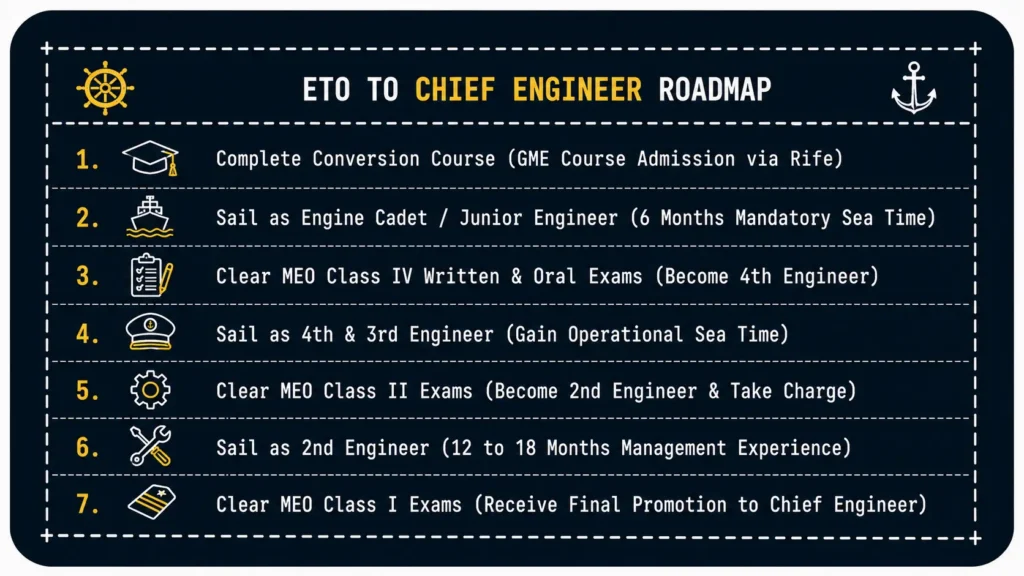
Step 1: Fulfill Educational Requirements and Complete the GME Course
To enter the marine engineering cadre, you need formal academic grounding in mechanical systems, fluid dynamics, heat engines, and naval architecture. Most ETOs join the maritime industry with a degree or diploma in electrical engineering, electronics, or instrumentation. Maritime regulatory bodies like the Directorate General of Shipping require candidates with non mechanical degrees to complete a bridge or conversion course.
This is where mechanical foundation programs become essential. If you hold a mechanical engineering degree prior to your electrical specialization, or if your local maritime administration permits entry into conversion programs, you must enroll in a Graduate Marine Engineering (GME) course.
At Rife, we help students take admission in GME course programs across top DG Shipping approved institutes in India. Through our pan India online classes and in person coaching in Surat, we assist candidates in meeting academic benchmarks and clearing sponsorship interviews for these conversion programs.
Essential Pre-Sea and Safety Requirements
Along with your academic conversion, you must ensure that all basic and advanced STCW safety training certifications remain valid. These include:
- Advanced Fire Fighting (AFF)
- Medical First Aid (MFA)
- Proficiency in Survival Craft and Rescue Boats (PSCRB)
- High Voltage Safety and Switchgear Training (at management level)
Step 2: Transition to Engine Cadet or Junior Engineer for Sea Service
Once you complete your formal conversion training or receive direct approval from your maritime authority to switch streams, you must step onto a vessel to earn mechanical sea time.
Your past sea service as an ETO demonstrates your general sea experience and familiarity with shipboard life. However, maritime rules state that ETO sea time does not count toward engine watchkeeping requirements on main propulsion machinery. You need actual hands on experience operating heavy mechanical plant equipment.
What You Will Do as a Junior Marine Engineer
During this conversion phase onboard, you will sail as an Engine Cadet or Junior Engineer. You must maintain a formal Training Record Book (TARB). Your daily activities will include:
- Overhauling auxiliary diesel engines, pumps, and air compressors
- Managing fuel oil purifiers and bilge water separators
- Learning boiler water testing and chemical dosing routines
- Taking main engine performance parameters during regular engine room watches
You typically need a minimum of six months of structured sea service as a trainee engineer on motor or steam vessels to become eligible for your initial marine engineering competency exams.
Step 3: Clear the MEO Class IV Competency Examinations
The MEO Class IV Certificate of Competency (CoC) serves as your official entry ticket into the certified marine officer hierarchy. Clearing this exam changes your designation from an electrical specialist to a certified Marine Engineering Officer.
The MEO Class IV evaluation process consists of two primary testing stages:
Written Examinations
You will appear for multiple written papers covering essential engineering subjects:
- Marine Engineering Knowledge (General)
- Marine Engineering Knowledge (Motor)
- Ship Construction and Ship Stability
- Marine Electrotechnology
- Ship Safety, Environmental Protection, and Maritime Law
Your background as an ETO gives you a massive advantage in the electrotechnology and automation papers. You can pass those subjects with ease, allowing you to dedicate your study time to core mechanical topics like thermodynamics and internal combustion engines.
Oral Examinations
Conducted directly by maritime surveyors, oral exams assess your real world practical knowledge. You must demonstrate how to handle emergency situations, respond to engine room blackouts, perform main engine overhauls, and keep a safe watch.
Passing these examinations earns you your MEO Class IV CoC, granting you permission to sail as a certified Fourth Engineer.
Step 4: Work Up Through the Operational Ranks
Holding a Class IV CoC places you on the operational rung of the engineering ladder. Your career movement from this point forward depends on accumulating valid sea service, proving your mechanical abilities, and passing management level examinations.
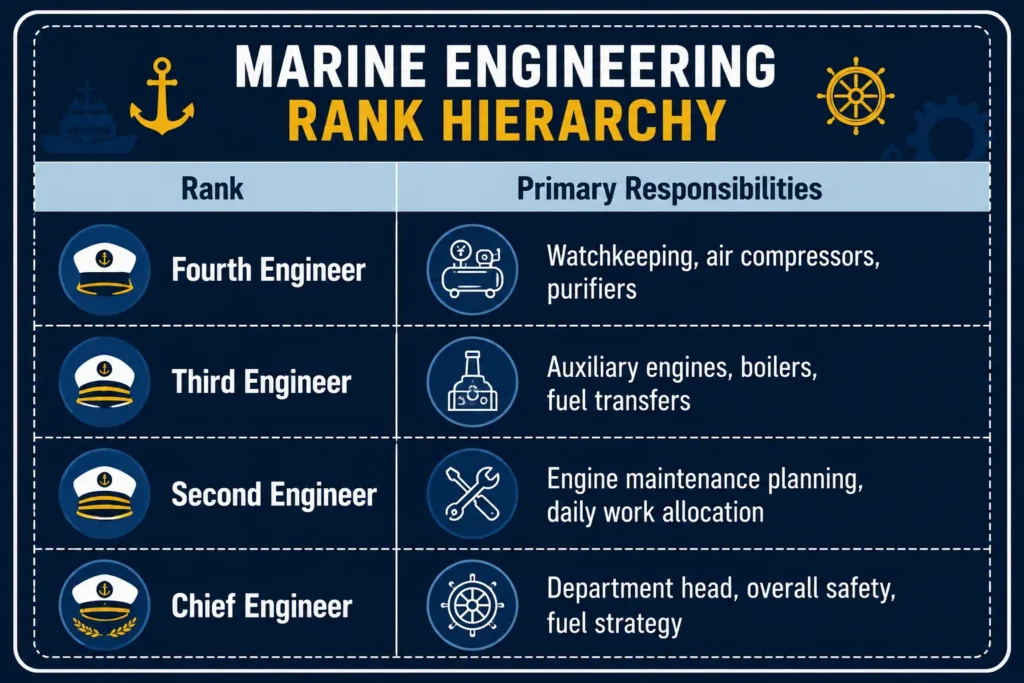
Fourth Engineer
As a Fourth Engineer, you take charge of an engine room watch. You handle the maintenance of purifiers, air compressors, sewage treatment plants, and fresh water generators. This rank helps you build strong mechanical instincts and get used to heavy manual work.
Third Engineer
After completing the required sea time as a Fourth Engineer (typically around 12 months), you step up to Third Engineer. In this role, you take charge of main auxiliary engines, boiler water chemistry, fuel oil transfers, and emergency safety equipment. You begin taking on deeper diagnostic roles for main propulsion machinery.
Step 5: Clear MEO Class II Exams and Serve as Second Engineer
To advance from Third Engineer to Second Engineer, you must step into the management tier of maritime certification. This requires passing the MEO Class II examination.
The Class II Process
You must return to shore to complete mandatory preparatory courses at an approved maritime training center. The MEO Class II exams test your understanding of advanced mechanical principles, system design, structural mechanics, and management practices.
Once you pass your written and oral modules, you receive your MEO Class II CoC.
Role of a Second Engineer
As a Second Engineer, you are the hands on manager of the engine room. You do not just fix machines; you organize the daily work schedule for the entire engine team. Your key responsibilities include:
- Planning and executing major overhauls of main engine cylinders, pistons, and bearings
- Ensuring strict compliance with environmental protection regulations such as MARPOL
- Managing spare parts inventory and fuel consumption logs
- Training junior engineers and engine ratings on safety practices
Serving as Second Engineer gives you the administrative and operational leadership experience required to manage an entire engine department independently.
Step 6: Pass MEO Class I Examinations and Achieve Promotion to Chief Engineer
The final milestone in your journey is securing the MEO Class I Certificate of Competency. This is the highest level of technical certification available in the merchant navy.
Mandatory Requirements
To apply for the MEO Class I exams, you must complete the required sea time as a certified Second Engineer. This requirement usually ranges between 12 and 18 months of sea service on vessels with main propulsion power matching or exceeding regulatory limits.
MEO Class I Assessment
The Class I examination evaluates your judgment as a future department head. The oral exam focuses heavily on:
- Crisis management during critical engine failures or groundings
- Resource management and crew safety under pressure
- International maritime laws, classification society rules, and flag state inspections
- Financial and operational optimization of fuel consumption and ship efficiency
Once you clear your oral examination and hold your MEO Class I CoC, your shipping company will evaluate your performance reports. Upon approval, you receive your final promotion to Chief Engineer.
Key Steps in Your Transition Journey
Here is a summary of the progression route, qualifications, and requirements you will navigate when moving from an ETO background to the top engineering rank onboard.
| Stage | Career Phase | Core Milestone | Primary Requirement |
| Phase 1 | Academic Entry | Pre-Sea Conversion Training | Engineering degree/diploma plus GME course admission |
| Phase 2 | Trainee Stage | Initial Sea Service | 6 months as Engine Cadet/Junior Engineer with TARB |
| Phase 3 | Operational Entry | MEO Class IV Certification | Pass written and oral exams to become 4th Engineer |
| Phase 4 | Operational Growth | Watchkeeping Sea Time | Serve 12 to 18 months combined as 4th and 3rd Engineer |
| Phase 5 | Management Level | MEO Class II Certification | Pass Class II exams and sail as Second Engineer |
| Phase 6 | Top Level Rank | MEO Class I Certification | Complete 12 to 18 months as 2nd Engineer, pass Class I |
Why Your ETO Background Gives You a Unique Advantage
Moving from an ETO position to a Chief Engineer pathway takes time and effort, but your electrical background gives you distinct strengths that traditional mechanical candidates often lack. Modern merchant ships are evolving into highly automated digital systems, making your specific skill set extremely valuable.
True Mastery Over Automation Systems
Modern vessels rely on computer networks, programmable logic controllers (PLCs), pneumatic automation loops, and complex sensor networks. Traditional marine engineers sometimes find electrical diagnostics difficult. Because you spent years troubleshooting these exact systems as an ETO, you can identify and solve automation glitches in minutes.
Deep Experience with High Voltage Power
As ships grow larger and adopt alternative fuels, high voltage power generation and distribution systems are becoming standard equipment. Your background gives you direct experience handling high voltage switchboards, vacuum circuit breakers, and power management equipment safely.
Complete Diagnostic Capabilities
A large portion of modern main engine breakdowns start with sensor faults, wiring issues, or control card failures rather than mechanical wear. As a Chief Engineer with an ETO background, you can inspect both the mechanical hardware and the electronic control architecture. This combined knowledge helps you solve issues faster and keeps the vessel running efficiently.
Realities and Challenges to Consider
While this career switch offers long term growth, you must enter the process with a realistic understanding of the practical challenges involved.
- Stepping Down Temporarily: You must accept a temporary drop in rank. Moving from a Senior ETO role to a Junior Engineer or Engine Cadet means taking a temporary reduction in pay and responsibility while gaining mechanical sea service.
- Demanding Study Requirements: Core mechanical subjects require dedicated preparation. You will need to study fluid dynamics, thermodynamics, strength of materials, and naval architecture to clear your engineering competency exams.
- Financial Planning: You must plan your finances carefully to cover periods ashore while completing modular courses, preparatory classes, and competency exam cycles.
How We Help You Achieve Your Merchant Navy Goals at Rife
Starting a career in marine engineering requires proper guidance, quality study materials, and structured training. At Rife, we support aspiring maritime professionals at every stage of their educational journey.
We provide comprehensive online and offline coaching to help candidates crack entrance exams and sponsorship interviews. Here is how we assist you:
- GME Course Guidance: At Rife, we help students take admission in GME course programs across top approved maritime institutes in India.
- Flexible Learning Formats: We offer pan India online live classes, recorded lectures, digital notes, and dedicated offline classroom training in Surat.
- Focused Preparation: Our study material, practice papers, and real exam style mock tests are developed by experienced Merchant Navy officers to keep you focused on what gets asked.
- 1 on 1 Mentorship: We offer individual counseling, doubt solving sessions, and speaking training to help you pass shipping company sponsorship interviews easily.
Whether you are preparing for your initial IMUCET entrance exams, seeking GME admissions, or aiming to build a strong foundation for your sea career, we provide all the resources you need under one roof.
Final Thoughts
Transitioning from an Electro Technical Officer to a Chief Engineer is a challenging but entirely practical goal. By acquiring the necessary mechanical qualifications through a GME program, completing your mandatory sea time on main propulsion systems, and clearing your MEO competency exams step by step, you can combine your electrical expertise with full operational command of a ship’s engine room.
With determination, clear planning, and proper educational guidance, you can navigate this career transition successfully and take your place at the head of the engine department.
Frequently Asked Questions
1. Can an ETO apply directly for the MEO Class IV examination without doing sea time as a Junior Engineer?
No, you cannot apply directly because maritime authorities require mandatory engine watchkeeping sea time on main propulsion machinery before allowing you to sit for MEO Class IV exams.
2. How long does it usually take to reach Chief Engineer starting from an ETO conversion?
The entire transition typically takes between six to eight years, depending on your sea time accumulation, exam preparation speed, and shipping company promotions.
3. Do I lose my electrical certifications after switching to the Marine Engineering Officer stream?
No, your original electrical qualifications remain valid, and your specialized electrical knowledge continues to serve as an asset throughout your engineering career.
4. Is the GME course mandatory for all ETOs wanting to become marine engineers?
The GME course is mandatory for candidates holding non mechanical engineering degrees, as it provides the foundation in mechanical engineering required by DG Shipping. At Rife, we help students take admission in GME course programs to fulfill this requirement smoothly.
5. What is the maximum age limit to enter a GME program for career conversion?
The standard age limit for GME course entry is generally up to 28 years, though specific maritime institutes and shipping sponsors may apply slight variations based on government guidelines.