
What Is Pump Priming and How to Do It?
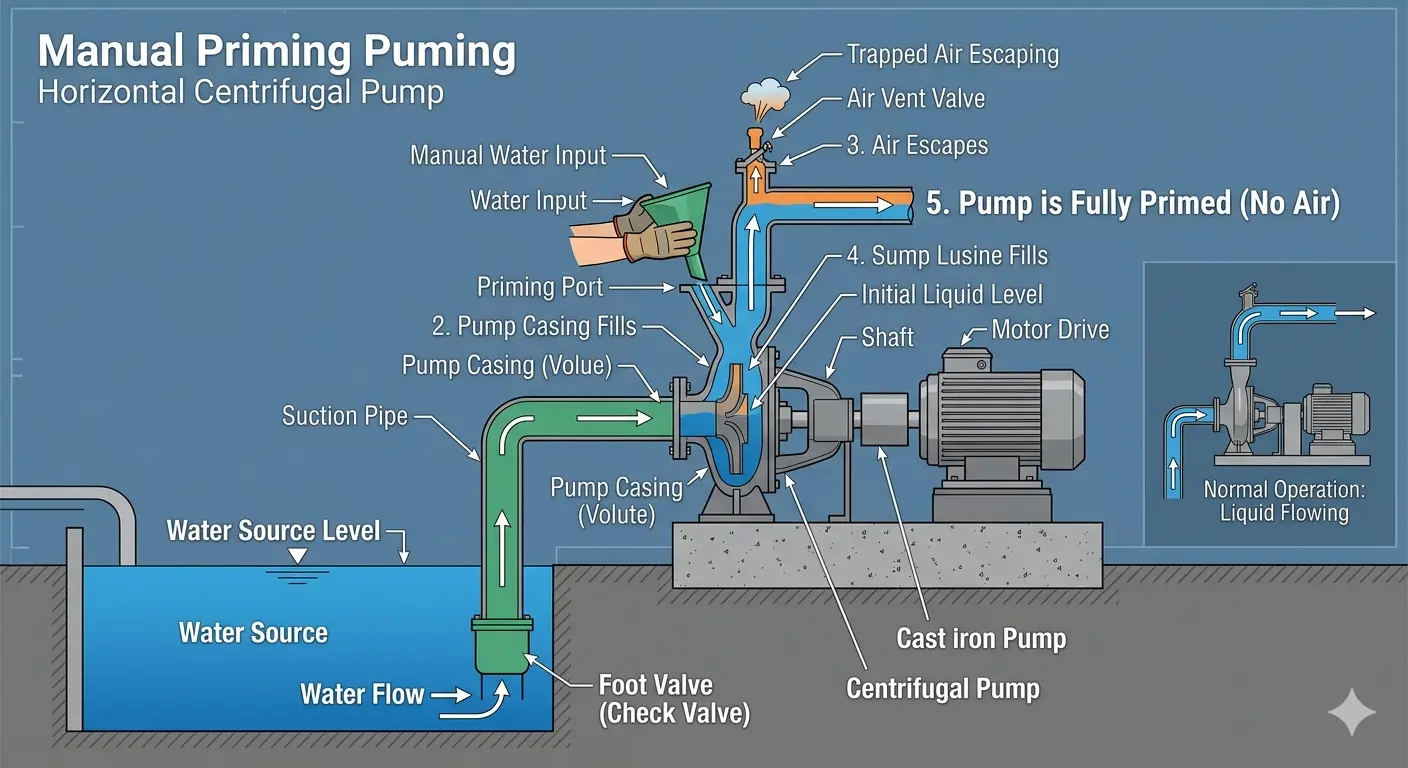
If you have ever spent time around machinery or worked with water systems, you might have heard someone say that they need to prime the pump. At first, it might sound like a strange term. However, priming is one of the most important steps in operating many types of pumps.
If you do not prime a pump correctly, the machine might not work at all. Even worse, you could end up damaging the equipment beyond repair. For those who are looking toward a career in engineering or the merchant navy, understanding these basics is essential.
Table of Contents
Understanding the Basics of a Pump
Before you learn about priming, you need to understand how a standard centrifugal pump works. Most pumps you see in houses, factories, or on ships are centrifugal pumps. These machines use a spinning part called an impeller.
When the impeller spins, it creates a force that pushes water or other liquids out through the discharge pipe. This action creates a low pressure area at the center of the impeller, which pulls more liquid in from the suction pipe.
The problem is that these pumps are designed to move liquids, not gases like air. Liquids are heavy and do not compress easily. Air is very light and can be squeezed into small spaces. A centrifugal pump depends on the weight and momentum of the liquid to create the pressure needed to move the fluid.
If the pump is full of air instead of water, it cannot create enough suction to pull the water up from a tank or a well. This is where priming comes into the picture.
The Definition of Pump Priming
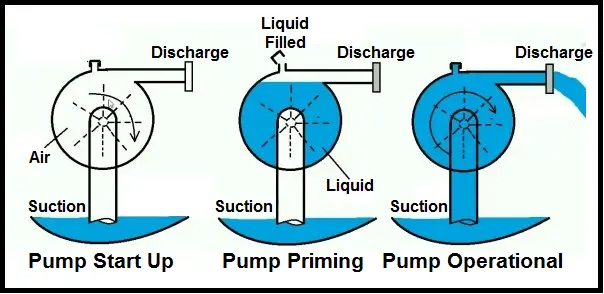
In simple terms, pump priming is the process of removing air from the pump casing and the suction pipe and replacing it with the liquid you want to pump. You do this before you start the pump. When you prime a pump, you make sure that the entire internal path from the source of the liquid to the pump discharge is filled with the liquid. Once all the air is gone, the pump can create the necessary vacuum to keep the flow going continuously.
Key Terms to Know
| Term | Simplified Meaning |
| Casing | The outer shell or housing of the pump. |
| Impeller | The rotating part that moves the liquid. |
| Suction Pipe | The pipe that brings liquid into the pump. |
| Priming | The act of filling the pump with liquid to remove air. |
Why Do You Need to Prime a Pump?
You might wonder why you cannot just turn the pump on and let it clear the air itself. There are several scientific and mechanical reasons why this does not work. You should pay close attention to these points because they explain the “why” behind the “what.”
1. Preventing Air Binding
Air binding happens when air gets trapped inside the pump casing. Because air is much lighter than water, the spinning impeller cannot throw it out with enough force to create a vacuum. Instead, the air just stays there, spinning around.
As long as that air is inside, the pump will not be able to draw any water from the source. The pump will run, but no water will come out of the tap or the hose. This is a waste of energy and can cause mechanical problems.
2. Avoiding Mechanical Damage
Many pumps use the liquid they are moving to stay cool and lubricated. When you run a pump that is full of air, there is no liquid to absorb the heat generated by the spinning parts. The friction between the seals and the shaft can lead to extreme temperatures.
If you let this happen for even a few minutes, the seals could melt or crack. This leads to leaks and expensive repairs. Priming ensures that there is always liquid present to keep things cool.
3. Cavitation Prevention
While cavitation is a complex topic, you can think of it as the formation of tiny bubbles that collapse with great force. If a pump is not primed correctly, small pockets of air can lead to these bubbles.
When they collapse, they can actually chip away at the metal on the impeller. Over time, your impeller will look like it has been eaten by acid. Proper priming helps keep the flow smooth and prevents this kind of erosion.
Recommend Read: 10 Life Lessons the World Can Learn from Seafarers
The Different Methods of Pump Priming
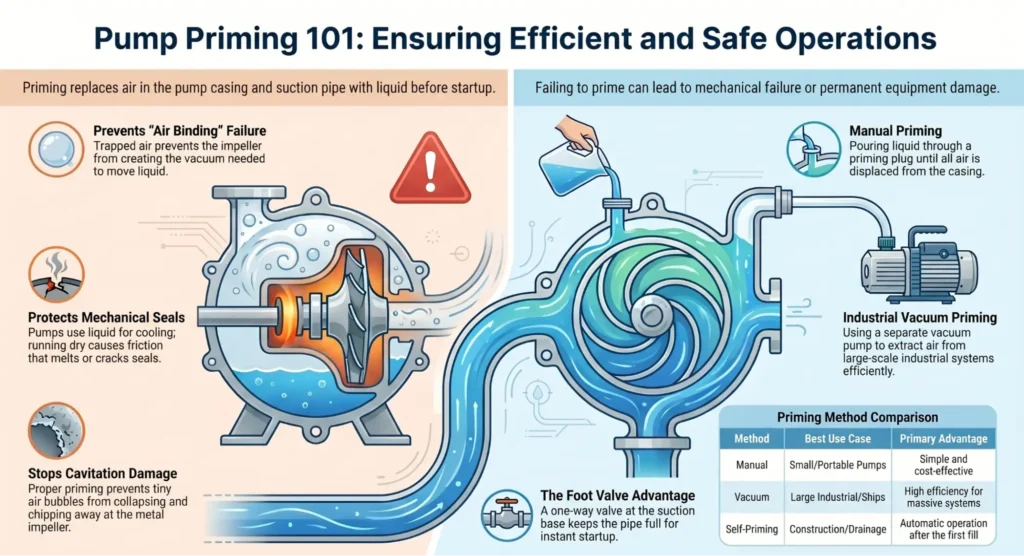
Depending on the size of the pump and where it is located, you might use different methods to prime it. Here are the most common ways of pump priming you will see in the industry.
Using a Foot Valve
A foot valve is a type of one way valve installed at the very bottom of the suction pipe. It allows water to enter the pipe but does not let it flow back out into the tank or well. When you use a foot valve, the suction pipe stays full of water even when the pump is turned off. This means you only have to prime the pump once. As long as the valve does not leak, the pump is always ready to go.
Vacuum Priming
In large industrial settings or on big ships, pouring water by hand is not practical. Instead, you use a small vacuum pump. This vacuum pump is connected to the main pump casing. When you turn on the vacuum pump, it sucks all the air out of the main pump and the suction line.
As the air leaves, the water from the source is naturally pushed up into the pump by atmospheric pressure. Once you see water in the sight glass, you know the main pump is primed.
Self Priming Pumps
Some modern pumps are designed to prime themselves. These are called self priming pumps. They have a special reservoir or tank built into the casing. This tank holds enough water to start the process.
When the pump starts, it circulates this water, which helps trap and carry away the air in the suction line. Eventually, the air is exhausted, and the full flow of water begins. While they are called self priming, you still have to make sure there is water in the built in tank before the very first use.
A Comparison of Pump Priming Methods
| Method | When to Use It | Main Advantage |
| Manual | Small, portable pumps. | Simple and costs nothing. |
| Foot Valve | Wells or deep tanks. | Keeps pump ready for instant start. |
| Vacuum | Large industrial systems. | Fast and very efficient. |
| Self Priming | Construction sites or drainage. | No manual work required after first fill. |
Common Problems During Pump Priming
Sometimes, even if you follow the steps, the pump might not prime correctly. You need to be able to troubleshoot these issues. Here are a few things that could go wrong.
Leaky Suction Pipe
This is the most common problem. If there is even a tiny hole in the suction pipe, the pump will suck in air instead of water. Since air is lighter, it is easier for the pump to pull air through a leak than to lift water from a tank. You must ensure all joints and pipes are airtight.
Blocked Foot Valve
If you are using a foot valve and it gets clogged with mud or debris, water cannot enter the pipe. No matter how much you try to prime the pump, it will not work because the path is blocked. Regular cleaning of the suction strainer is necessary to prevent this.
Worn Out Seals
If the internal seals of the pump are old and worn, they might allow air to leak into the casing from the outside. This ruins the vacuum. If you see water leaking out of the pump shaft when it is off, it is a sign that the seals are bad and might be letting air in when the pump is on.
Recommended Read: Top 10 Major Ports of India
Important Safety Precautions
Working with pumps involves electricity, fast moving parts, and sometimes high pressure. You should always keep the following safety rules in mind.
- Never run a pump dry for long periods. If it does not catch its prime within a minute or two, turn it off and check for problems.
- Always wear protective gear if you are pumping chemicals or very hot water.
- Ensure the electrical connections are waterproof and grounded.
- Keep your hands and clothing away from the spinning shaft of the pump.
The Importance of Pump Priming in Different Industries
You will find pumps everywhere, and priming remains a universal requirement. In the merchant navy, pumps are used for fuel, cooling engines, cargo operations, and even for fighting fires. Imagine a fire on a ship where the fire pump was not primed.
The delay could be disastrous. In agriculture, farmers use pumps to irrigate their crops. If the pump is not primed, the crops do not get water. In your own home, if you have a borewell, the pump requires priming to bring water to your overhead tank.
Key Takeaways
To conclude, priming is the essential act of preparing a pump for operation by removing air. It is a fundamental part of fluid mechanics that you will encounter frequently if you pursue a technical career. By understanding how to prime a pump and why it is necessary, you protect the equipment and ensure that systems run efficiently.
| Key Concept | Why It Matters |
| Air Removal | Allows the pump to create a vacuum. |
| Cooling | Prevents the pump seals from melting. |
| Vacuum Maintenance | Ensures a steady flow of liquid. |
| Troubleshooting | Helps identify leaks and blockages quickly. |
You now have a solid understanding of pump priming. Whether you are looking at a career at sea or in a factory, these basics will serve you well. Always remember that a well primed pump is a happy pump, and taking those few extra minutes to do it right will save you a lot of trouble in the long run.
Frequently Asked Questions
1. What is meant by priming a pump?
Priming is the process of filling a pump casing and its suction pipe with liquid to remove any trapped air or gases. This step is necessary because most pumps cannot create enough suction to pull liquid if the internal components are filled with air.
2. What is the process of pump priming?
The process involves pouring liquid into the pump through a priming plug or using a vacuum device to suck the air out so the liquid can rise. Once the entire internal volume is filled with liquid and all air bubbles are gone, the pump is ready to be started safely.
3. What is the purpose of pump priming?
The main purpose is to ensure the pump can create the pressure difference needed to move the liquid from the source to the discharge. It also serves to lubricate and cool the internal seals and moving parts that would otherwise overheat if run dry.
4. What is priming and cavitation?
Priming is the act of removing air before startup, while cavitation is the formation and collapse of vapor bubbles during operation due to low pressure. Proper priming helps prevent early cavitation by ensuring a solid and steady flow of liquid through the impeller.
5. What is priming and its types?
Priming is the preparation of a pump for work, and it can be done in several different ways depending on the equipment. The most common types include manual priming by hand, using a foot valve to keep water in the pipe, vacuum priming with a separate pump, and self priming systems.