
Marine Knowledge for IMUCET: Preparation Tips
If you want to join the Merchant Navy after your 10th or 12th standard, you must clear the Indian Maritime University Common Entrance Test. This exam is known as IMUCET. It is the most important national level entrance test for students who want to build a career at sea. Whether you want to pursue a Diploma in Nautical Science, a Bachelor of Science in Nautical Science, or a Bachelor of Technology in Marine Engineering, clearing this test is mandatory.
When you start looking at the syllabus for this entrance test, you will see standard subjects like Physics, Mathematics, Chemistry, English, and General Aptitude. But there is one specific area that confuses many fresh students.
That subject is Marine Knowledge. Most schools do not teach anything about ships, shipping laws, or how the ocean transport system works. This makes Marine Knowledge a unique section where you can score high marks if you prepare well, or lose marks if you ignore it.
Marine Knowledge is not just important for your written IMUCET entrance exam. It is also a major part of your selection process during company sponsorship interviews. Shipping companies want to see if you actually know what the Merchant Navy is before they sponsor your education.
They want to check your basic awareness about life at sea, types of vessels, and standard safety practices. This blog will guide you through everything you need to know to prepare for this section. You will learn what topics to study, how to manage your time, and what resources you should use to get a top rank.
Table of Contents
What is Marine Knowledge and Why Does It Matter
Marine Knowledge refers to the basic understanding of the shipping industry, how merchant ships operate, the parts of a ship, and the international rules that govern the oceans. When you sit for the written exam, you will face multiple choice questions that check your general awareness about these topics.
Many students make the mistake of studying only Physics and Mathematics. While those subjects carry a lot of weight, Marine Knowledge gives you a major advantage. Here is why you should focus on this subject:
- It helps you stand out in sponsorship tests conducted by top shipping companies.
- It saves you time during the actual exam because these questions are direct and do not require long calculations.
- It builds your confidence for the personal interview round where captains and chief engineers will test your sea awareness.
- It prepares you for the initial months of your pre sea training college because you will already know the basic terms.
To make your preparation easy and structured, you can use specialized study resources. You should look at Rife’s Marine Knowledge for IMUCET 2027 Exam Study Material to get a clear hold of these concepts without reading thick textbooks meant for senior officers.
Key Marine Knowledge Topics You Must Study
You do not need to become a ship captain before the exam, but you must know the foundational concepts. The questions asked in the entrance test are basic but specific. Here is a detailed breakdown of the main areas you need to cover during your self study or coaching sessions.
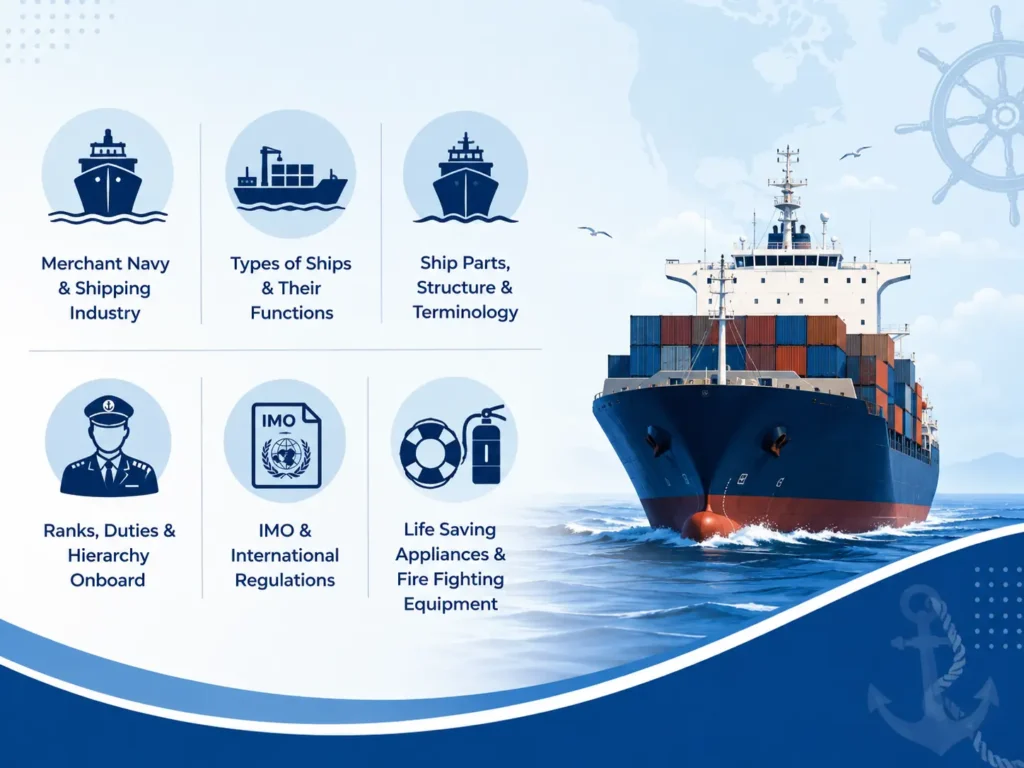
1. Introduction to the Merchant Navy and Shipping Industry
You must understand what the Merchant Navy actually does. It is a commercial industry responsible for transporting goods, oil, food, and machinery across the world using huge vessels. You should study the basic history of shipping, how trade routes work, and the role of the merchant fleet in global economy.
2. Types of Ships and Their Functions
Ships are built differently based on the cargo they carry. You need to know the names and functions of the common types of vessels.
- Bulk Carriers: These ships carry loose dry cargo like coal, iron ore, grains, and cement.
- Container Ships: These vessels carry manufactured goods packed in standard metallic containers.
- Tankers: These are specialized ships designed to carry liquid cargo like crude oil, chemicals, liquefied petroleum gas, and liquefied natural gas.
- Ro Ro Ships: This stands for Roll On Roll Off. These vessels are used to transport wheeled cargo like cars, trucks, and buses.
- Passenger Ships: These include cruise ships and ferries that transport people across ports.
3. Ship Parts, Structure, and Terminology
The shipping industry does not use standard English words for directions or parts. You must learn the correct maritime vocabulary. For example, you need to know these basic terms:
- Bow: The front part of the ship.
- Stern: The rear or back part of the ship.
- Port Side: The left hand side of the ship when you are facing the front.
- Starboard Side: The right hand side of the ship when you are facing the front.
- Bridge: The control room of the ship where the navigation takes place.
- Engine Room: The compartment where the main engine and generators are located.
- Hull: The main body of the ship that floats in the water.
- Keel: The bottom most spine of the ship’s structure.
4. Ranks, Duties, and Hierarchy Onboard
Life on a ship follows a strict chain of command. You must understand the two main departments onboard, which are the Nautical or Deck Department and the Engineering Department.
- Deck Department: This department handles navigation, cargo operations, and safety. The hierarchy starts from Deck Cadets, goes up to Third Officer, Second Officer, Chief Officer, and finally the Captain or Master.
- Engine Department: This department maintains the machinery, main engine, electrical systems, and boilers. The hierarchy starts from Engine Cadets or Junior Engineers, goes up to Fourth Engineer, Third Engineer, Second Engineer, and leads to the Chief Engineer.
- Saloon Department: This department handles cooking and catering services for the crew members.
5. International Maritime Organization and Regulations
The oceans are international territories, so there must be global rules to prevent accidents and pollution. You must study the basic functions of the International Maritime Organization, which is a specialized agency of the United Nations. You should know the full forms and basic purposes of these important international conventions:
- SOLAS: Safety of Life at Sea. This convention deals with ship construction, safety equipment, and emergency procedures.
- MARPOL: Marine Pollution. This rule covers the prevention of pollution by oil, chemicals, sewage, and garbage from ships into the sea.
- STCW: Standards of Training, Certification, and Watchkeeping. This sets the qualification standards for masters, officers, and watch personnel on merchant ships.
6. Life Saving Appliances and Fire Fighting Equipment
Safety is the highest priority at sea. You will face questions regarding the basic tools used during emergencies. You should study the purpose of lifeboats, liferafts, lifebuoys, lifejackets, and immersion suits.
You must also learn about different classes of fires and the types of portable fire extinguishers used to put them out, such as water, foam, carbon dioxide, and dry chemical powder extinguishers.
Step by Step Preparation Strategy for the Exam
Now that you know the topics, you need a plan to study them alongside your regular 11th and 12th standard school subjects. Here is a practical sequence you can follow to master this subject.
Step 1: Start with Basic Maritime Terms
Do not jump into complex international laws on day one. Spend your first week learning the basic words used on ships. Understand the layout of a ship by looking at simple labeled diagrams. Learn the difference between port and starboard, or forward and aft. This creates a base for your learning.
Step 2: Use Targeted Study Material
You do not need to scroll through random websites or read huge marine engineering books. You should get a book that is written specifically for entrance exams. A great option is Rife’s Marine Knowledge for IMUCET 2027 Exam Study Material. This resource contains recorded concept video sessions, easy notes with diagrams, and direct explanations that match the current exam pattern.
Step 3: Memorize Ship Ranks and Roles
Make a clear chart of the rank structure on a whiteboard or a notebook. Understand who reports to whom. Memorize the exact duties of a Captain, a Chief Engineer, and a Deck Cadet. This is a favorite topic for interviewers and written tests.
Step 4: Solve Previous Year Questions
Look at how questions are framed in the actual entrance test. Sometimes the questions are about global ports, famous canals like the Suez Canal and Panama Canal, or basic general knowledge related to shipping. Solving past questions helps you understand the depth of study required.
Step 5: Take Regular Mock Tests
Testing yourself under a strict time limit is the only way to know if you can recall the information during the actual exam day. You should attempt Rife’s free mock test to check your current preparation level without spending any money. This will show you your weak spots instantly.
Pre Sea Courses You Can Target
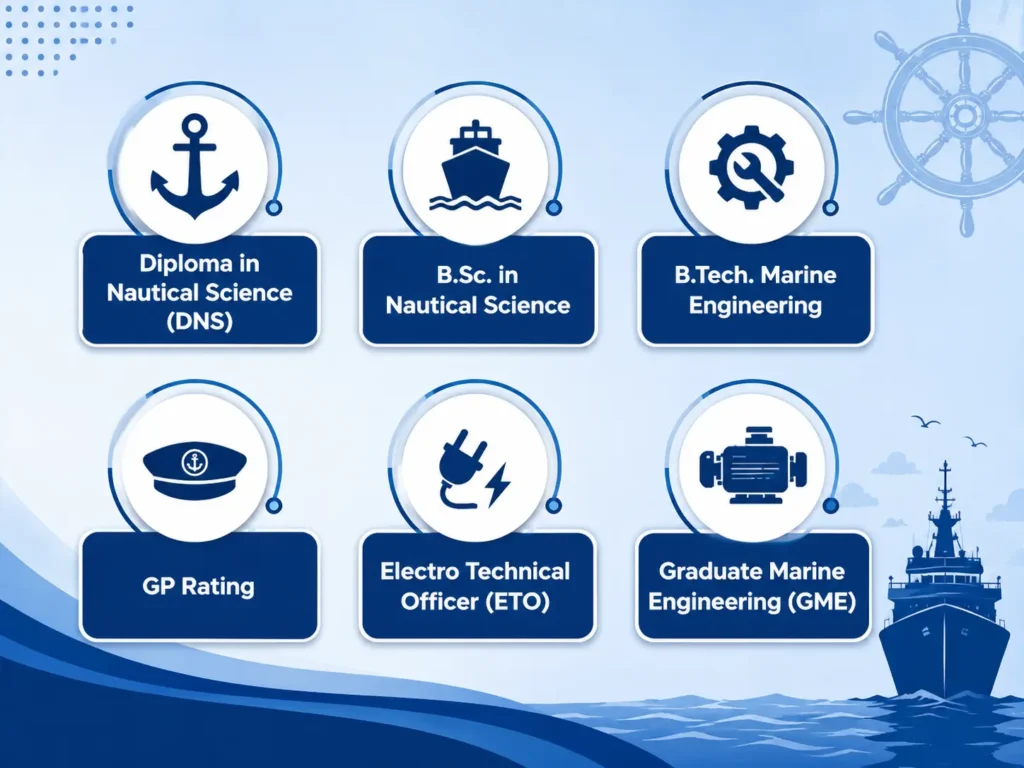
Depending on whether you are appearing for exams after your 10th standard, 12th standard, or after your graduation, you can choose different entry paths into the Merchant Navy. Here is a brief look at the courses you can choose from:
- Diploma in Nautical Science (DNS): This is a 1 year course after your 12th standard science stream. It is a direct way to become a ship officer because it requires you to clear a sponsorship exam from a shipping company before you join the college.
- B.Sc. in Nautical Science: This is a 3 year degree program after your 12th standard. It teaches you navigation, cargo handling, and ship operations so you can become a deck officer.
- B.Tech. Marine Engineering: This is a 4 year degree course after your 12th standard. It trains you to maintain and run ship engines and heavy machinery.
- GP Rating: This is a 6 month course that you can join right after your 10th standard. It is the quickest way to join the merchant fleet as a rating or crew member.
- Electro Technical Officer (ETO): This is a specialized course after graduation for students who hold a diploma or degree in electrical or electronics engineering. You will handle all electrical and electronic systems onboard.
- Graduate Marine Engineering (GME): This is a 1 year course for mechanical engineering graduates who want to convert their stream and become marine engineers.
Common Mistakes to Avoid in Marine Knowledge Prep
Many smart students fail to get a good rank because they make simple errors during their preparation phase. You should stay aware of these pitfalls:
- Relying on General Guesswork: Many students think that Marine Knowledge is just general common sense. They guess answers during mock tests, which leads to heavy negative marking.
- Ignoring Shipping Industry Abbreviations: The maritime world uses many short forms like SOLAS, MARPOL, IMO, LSA, FFA, and STCW. Do not just memorize the short names. Learn the exact full spelling and the year they came into force.
- Not Preparing for Sponsorship Simultaneously: Getting a good rank in IMUCET is useless if you do not have a sponsorship from an approved shipping company for courses like DNS. You must prepare your Marine Knowledge keeping both the written test and the company interview in mind.
- Studying Obsolete Syllabuses: The shipping industry changes its rules regularly. If you study from old internet articles, you might memorize outdated facts. Always use updated study materials.
How Rife Consultancy Can Help You Succeed
Preparing for an industry specific exam like IMUCET can feel difficult when you are doing it alone. Rife Consultancy provides a complete learning ecosystem designed specifically for maritime aspirants. We offer both PAN India online classes and in person coaching at our dedicated training facility in Surat.
Here is what you get when you choose to prepare with Rife:
- Expert Faculty: You will learn directly from experienced Merchant Navy Officers who know exactly what happens on ships and what questions are asked in modern exams.
- Comprehensive Study Material: You get access to exam focused books, PDFs, and solved question banks. You do not have to waste time searching for notes online.
- Real Exam Style Mock Tests: Our online test platform provides time bound, auto evaluated mock tests with All India Rank comparisons. This helps you track your speed and accuracy.
- Focused Training Program: Our program includes live or offline classes for Physics, Mathematics, English, Reasoning, and General Knowledge. Along with this, you receive specialized shipping company sponsorship preparation, daily practice sheets, speaking and interview training, and one-on-one counseling sessions.
Rife has a proven track record of producing top performers. For example, our star student Rajeev Dara secured an All India Rank of 02 in the IMUCET exam. He credits his confidence and success to the focused training, mentoring, and mock tests provided by Rife Consultancy during his preparation journey.
Recommended Study Material Options
To streamline your preparation, you should look into the specific study bundles created by experts. You do not need to purchase multiple books from different publishers.
You can rely on the IMUCET Study Material + Mock Tests Series offered by Rife. This bundle includes chapter wise notes, previous year questions, and in depth explanations that are easy to understand even if you have zero background in shipping.
For the specific general awareness section, you should get Rife’s Marine Knowledge for IMUCET 2027 Exam Study Material. This targeted package ensures you cover every single topic mentioned in this blog without wasting time on extra theory that is never asked in the entrance test.
Conclusion and Final Advice
Clearing IMUCET and securing a sponsorship is your golden ticket into the Merchant Navy. Marine Knowledge is the bridge that connects your school education to your future life on a ship. Treat this subject with respect, give it at least an hour of dedicated study every day, and practice as many multiple choice questions as possible.
Start your preparation today by evaluating your baseline score. Go ahead and take Rife’s free mock test to see where you stand right now. Once you identify your weak areas, utilize the IMUCET Study Material + Mock Tests Series to build your speed, clear your doubts, and secure your place at sea. Keep working hard, stay disciplined, and you will see your name on the rank list.
Frequently Asked Questions
1. What is Marine Knowledge in the IMUCET exam?
Marine Knowledge is a section that tests your basic awareness of the shipping industry, types of ships, and shipboard operations. It helps examiners see if you understand the basics of the Merchant Navy before you join.
2. Can a commerce or arts student apply for the Marine Knowledge course?
Yes, any student preparing for maritime entries like GP Rating or catering can study this course. However, for engineering and deck officer degrees, you must have science in your twelfth standard.
3. How will Rife’s study material help me clear the interview?
Rife’s material includes real interview questions and basic ship terms taught by real captains and officers. This builds your confidence so you can answer oral questions easily during your company sponsorship selection.
4. Is there a negative marking system for Marine Knowledge questions in IMUCET?
Yes, IMUCET has a negative marking system where marks are deducted for every wrong answer you choose. This is why you should avoid guesswork and prepare accurately using the IMUCET Study Material + Mock Tests Series.
5. Where can I try a sample paper before buying the full course?
You can practice right away by attempting Rife’s free mock test available on our platform. This will show you the exact style of marine questions asked in the actual entrance test.